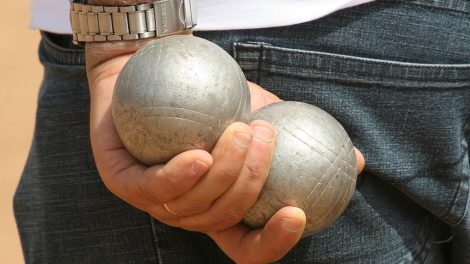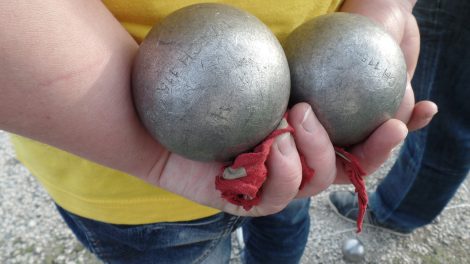

It will feel quite strange when throwing a boule for the first time with the palm of your hand facing downwards,. "Surely", you think, "if the palm of my hand faced upward I could throw a boule much more easily"? The truth is, yes, you could throw more easily, but could you throw both accurately and use the correct amount of power required?
You don't only need to throw straight, but you need to stop your boule near to the target. Remember, when pointing you need accuracy, the correct amount of weight (or power) plus an ability to turn the boule to the right or to the left, and when necessary apply backspin to stop the boule more quickly. You will find difficulty doing all these things with your palm uppermost.
When throwing your boule keep your arm fully extended all the time Swing your arm back as far as possible and then forward again. Judge the force you need to carry your boule to its target and where to release it as the hand rises in front of your body.
3. Make sure, when you release the boule that the fingers of the hand are fully extended and pointing towards the target, you only need one relaxed or bent finger to send the boule away from its true course; so concentrate when you throw a boule.
POINTING
1.
The art of pointing always, is to get your boule exactly where you want it. Pointing is the term usually given to the throwing of the boule towards the coche. You may sometimes want your boule as close to the coche as possible.
At other times you may want your boule to block a space in front of the coche between other boules.
And yet other times when you want your boule in front of an opponents boule to give you an advantage. It is by consistent and accurate pointing very often that you can frustrate and demoralise the opposition. This is not an easy thing to do, and the only way to get near to it is, to practise often. But pointing alone is not the full answer.
Read also the subject of "Terrain" Both these go together.
2.
There is no "one stance" from which to point. Some stand upright, others have a slight bend in their bodies, others half sit with one hand supported on the knee, others bend until their hands almost touch the ground, and yet others sit in a squatting position .
All have their advantages and their disadvantages and all have their followers. Try all of them in your practise sessions, and use those that you feel comfortable with and give you the best results and the most satisfaction.
Lars Refn was one of the founders of the Copenhagen Petanque Club in Denmark. He is also an illustrator, and has produces a vast number of t-shirts with petanque as the theme over the years.
A positive newsflash fron Chiltern - the young ones have started playing petanque!
We often get questions about when you are to old to play petanque. Some say 90, some 100 and some 120..
A report from Tim Truluck in Charente, France.
This month we celebrated a big number - 10 years
Petanque for beginners: Three main pointing throwsPetanque for beginners: Throwing your boulePetanque for beginners: Playing equipmentPetanque beginners pages - an introduction
Playing Indoos (2 )Illegal Petanque Exposed (5 )most difficult shot/throw? (5 )Nice one! (1 )Terrain for SANDY soils (Florida) (52 )petanque surface aggregates (2 )Right size boule (3 )Size (1 )Article 37 – Incorrect Behaviour, (5 )YouTube has some great clips (1 )2nd boule played although 1st one made it (7 )Sibu Petanque Association (PPS)- OFFICIAL WEBSITE (MALAYSIA) (1 )Where to play petanque in Thailand (9 )Marked Terrain? (2 )World Petanque Day June 2nd (7 )