
No piste/terrain plays the same as so much depends on its construction, but several points are important.
1. The Dimensionsneed to be 4 meters wideand 15 meters long. This will enable players to exercise the full range of their ability in playing over distances from 6 to 10 meters and at various angles.
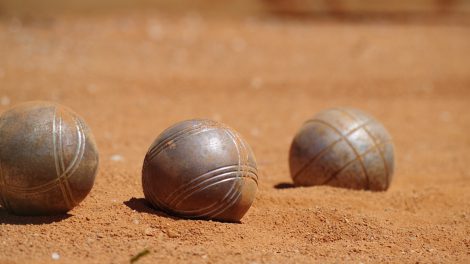
2. The surface is important. A loose surface such as gravel (10mm to dust ) is preferred since its properties tend to hold the Boules back from rolling too far.
3. The construction depends much on the site and finance available. Two methods for consideration:
A. If the ground is relatively flat and well drained, construction can take place on top of the existing surface.
B. If the site has a slope and needs some form of drainage, much more work is involved and also expense.
METHOD 'A'.
1. Check site dimensions, drainage etc.
2. Remove grass by cutting away the turf (or any other organic material).
3. Remove loose soil.
4 Place round outside the area some form of boundary retainer approximately 9" high, spread about 1" of fine gravel and roll. The surface can then be top dressed as required.
METHOD 'B'.
1. Check site dimensions as for method 'A'.
2. Remove grass by cutting away the turf, i.e. organic material.
3. Remove soil to form a level base.
4 The boundary retainer will have to be increased due to the increase depth of crushed limestone i.e. 5" if a poor drainage area (special attention should be given to provide a water escape route). Carry on as for method 'A'. Water escape route can be constructed by the following methods.
A. LAND DRAINING PIPE.
Dig a trench deep enough to create a fall from the terrain to the outlet. Lay in drainage pipes, cover with pea gravel and back fill with top soil.
B. COMMON SOAK-AWAY.
Carry out as for land drain. At the outlet end dig a hole 11/2 meters deep by 1 meter wide Fill with hard core (broken bricks etc.), cover with plastic sheet or cap with concrete finish about 300mm below the surface. Back fill with top soil.
C. FRENCH DRAIN.
About a meter from the outside of the terrain area that floods, dig a trench. Fill with 25mm/16mm pebbles up to the surface. This will act as a soak-away and a walk area.
DIMENSIONS AND CONSTRUCTION OF A PETANQUE COURT
CONSTRUCTION.
1. Rock dust or decomposed granite ( D.G.) with 15% of rock , 3/8 to 1⁄2 inch in diameter, in depth of 2 to 2 3⁄4 inch, compacted at 90%. 2. Gravel and soil mix in depth of 2 to 2 3⁄4 inches. 3. Rubbles, broken bricks, rocks of 6 inch in diameter, in depth of 6 to 8 inches. Set a 3% slope on the entire length of the playing Court to insure proper drainage. 4. Blocks with large cracks.
SIZE OF THE COURT AND DIMENSIONS.
To accommodate 2 teams ( 6 players ), the court or playing area must measure at least 15 meters x 5 meters ( 49 1⁄2 feet x 16/ 1⁄2 feet ). The number of teams or players that you like to accommodate in one time must multiply these dimensions. White sand, chalk, small rope, 1-inch flat plastic tape or planks can separate the Courts or playing area.
We have done some redesigning here, and things are starting to look a bit more like 2013. The last change was back in 2005, and that was our 5th redesign. So here we are in the middle of our 6th change since 1996.
FInally there is a petanque-app for the android-users out there. And it is free. The perfect xmas-present perhaps?
We have set up a system that will publish 2 new postcards to twitter every day from petanque.org. It will not work forever of course, in only 2,5 years we will start with re-runs of cards we have already previously published on Twitter . We do have a lot of petanque-postcards here.
We have a very nice collection of postcards here on petanque.org, and all of them are about petanque of course. Currently we have more than 1750 postcards available for your enjoyment.
The world wide petanque and boule community, by and for users.